Calgary Real Estate and Community News

Could this possibly be the BEST Real Estate blog in Calgary? Perhaps! Either way, we sure know how to throw a good blog. 

June 11, 2019

Debt blamed in credit crisis could help Canada with housing risk

The type of securities blamed for triggering a credit crisis in the U.S. a decade ago could now be part of the solution in Canada, where a cooling housing market is a key risk to its US$1.7 trillion economy.

The Bank of Canada is discussing ways to encourage a more robust market for residential mortgage-backed securities with potential investors. Only about $1.5 billion of Canadian uninsured mortgages have been pooled in RMBS deals, or about 0.1 per cent of the country’s mortgage debt, according to rating company DBRS Ltd. No lender has widely marketed such a deal since September, when private lender MCAP sold $254 million of the notes.

While previous efforts to kick-start an RMBS market have borne little fruit, this time may be different as Canadian home prices are rising at the slowest pace this decade amid higher interest rates, regulatory changes and tax increases designed to reign in surging prices, particularly in Toronto and Vancouver.

“While lenders are very well equipped to manage normal market risks, I suspect they are rather unwilling to take on the additional risk of future government intervention in the housing markets,” said Andrey Pavlov, a professor of finance at Beedie School of Business of Simon Fraser University in Greater Vancouver. “Therefore, lenders are likely more interested today than they have ever been in hedging their residential real estate exposure, and mortgage backed securities would be a good way to do so.”

Lenders create mortgage-backed notes by packaging property loans into securities of varying risk and returns -- too much risk it turned out during the U.S. financial crisis when shady loans made it into MBS tranches. There’s been little evidence risky mortgages have become a feature in Canada. In addition, mortgages are “full recourse” in most of the country, meaning lenders can pursue borrowers even after they’ve walked away from the property.

On top of raising funds, the sellers of the underlying assets can reduce the regulatory capital they have to set aside to cover eventual losses should they meet certain conditions, including selling significant portions of the lower rated, higher risk bond tranches.
Embedded Image

Longer Term

The notes are repaid as borrowers pay down debt. The legal duration of the bonds could be significantly longer than the expected repayment rate suggests. This could be a useful tool for lenders to offer longer-term mortgages in a country where most of the home loans have a 5-year term. The repayment of the bonds can be adapted to the repayment of the underlying collateral.

Up until 2016, Canadian lenders relied heavily on Canada Mortgage & Housing Corp., the country’s national housing agency to insure mortgages with down payments of less than 20 per cent and then packaged those loans into mortgage-backed securities to fund obligations. But as part of its efforts to curb taxpayer exposure to the housing market, the government made it more difficult to get insurance. The market for uninsured mortgages took off -- MBS based on the debt less so.

“There’s an ongoing education job around investors just to highlight the difference between that product and the CMHC product, and we are investing in that so that the market grows over time,” Bank of Montreal Chief Financial Officer Tom Flynn said in an interview last week. The RMBS “market is not nearly as developed as the CMHC mortgage bond market is. I would say our hope is over time that market will grow, and the banks generally I believe are interested in issuing that product.”

The Canadian Fixed-Income Forum, a Bank of Canada-led group made up of participants in the bond market, has been working since at least last year to analyze the conditions and incentives that would be required to expand interest in the asset class, according to the minutes of their meetings. It conducted a focus group last month with mostly buy side institutions about the disclosure on the underlying collateral and other features they may require. The group, known as CFIF, was scheduled to discuss the issue again at a June 4 meeting.

Data Portal

One way to bolster investors’ confidence in deals would be by setting up a public database of mortgages used in securitization deals including anonymized details of the borrower, property and loan performance, Bank of Canada governor Stephen Poloz said last month. A similar project was supported by the European Central Bank in a bid to re-start sales of asset-backed securities after investors shunned hard-to-value assets following the seizure of the U.S. mortgage securitization market in 2007.

“A loan level data portal is a great idea,” said Imran Chaudhry, a senior portfolio manager at Forresters Asset Management Inc., which manages about $8.5 billion of assets and has invested in Canadian securitizations. “Issuing public RMBS deals would provide a larger investor base to the issuers and help establish a diversified funding source for them over a longer term.”

The starting point of RMBS as a funding tool isn’t the most attractive for banks as investors may demand an extra yield of 20 to 30 basis points over their senior bail-in debt in a stable market situation, said Chaudhry, who is part of the CFIF. Yet, once a market develops the spreads will tighten and it will make economic sense for the lenders to issue, he said.

Uninsured Surge

All these efforts are occurring at a time when the household debt-to-disposable income ratio in Canada at the end of 2018 hit a record high of 175 per cent, up from 136 per cent in 2006. By contrast, U.S. household debt to disposable income ended last year at 98 per cent, the lowest since 2001, according to data compiled by Bloomberg.

“A key domestic risk is a sharp correction in the housing market,” officials at International Monetary Fund said in May 21 statement about the state of the Canadian economy. To be sure strong immigration, underlying strength in the economy and an unemployment rate near historic lows argues against such a scenario.

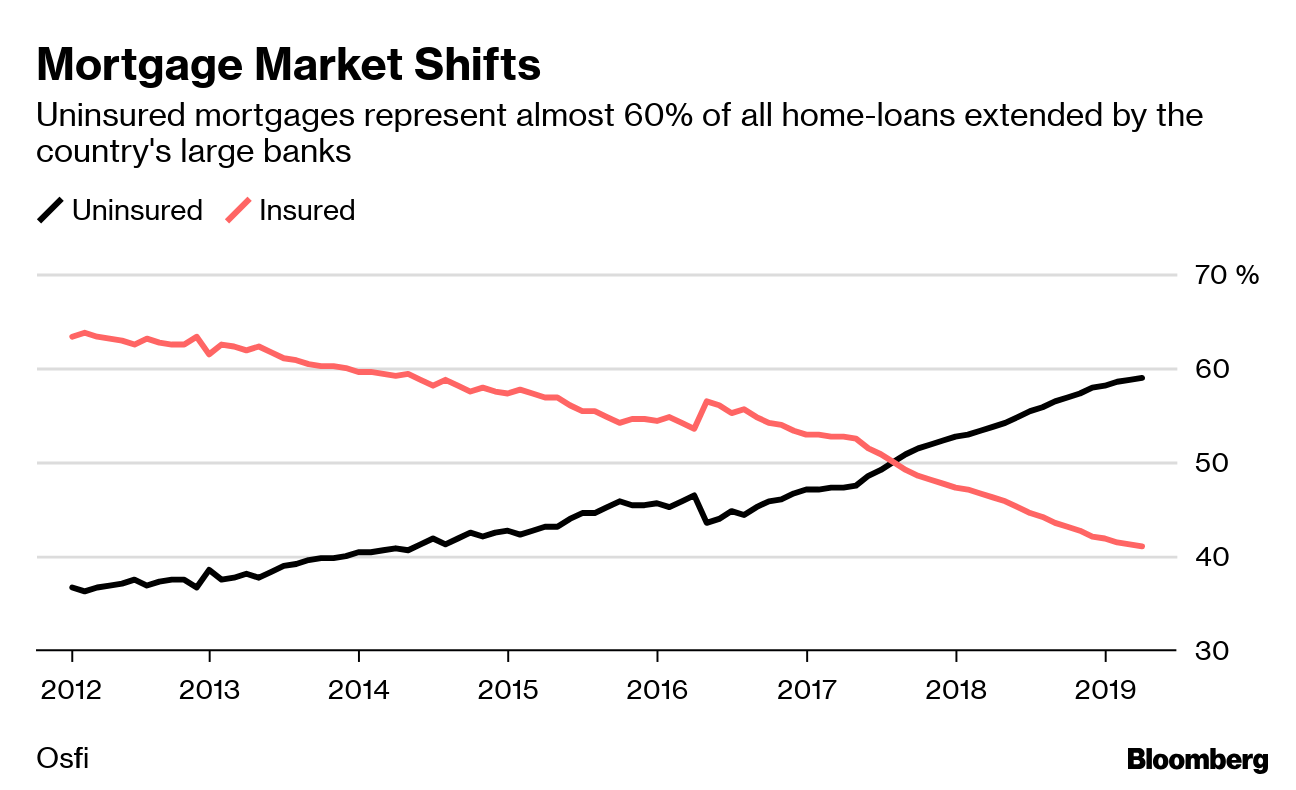
Lenders’ exposure to an eventual downturn may be increasing. According to the Office of the Superintendent of Financial Institutions, the Canadian bank regulator, the ratio of uninsured over insured mortgages has jumped to the highest since 1997.

At the end of March, the volume of uninsured mortgages surged 14 per cent from a year ago, accounting for about 59 per cent of the $1.17 trillion of home loans at Canada’s federally regulated banks, while insured home loans fell 7.8 per cent from a year ago, according to data from OSFI. On Tuesday, the regulator announced it was increasing a domestic stability buffer for systemically important banks to two per cent of their risk weighted assets from 1.75 per cent, effective Oct. 31, citing vulnerabilities that include household indebtedness.

“To be clear, the system is not broken—it has served Canadians and financial institutions well,” said Poloz in a May 6 speech in Winnipeg. “We should not stop looking for improvement.”
 

Source

May 14, 2019

Economics estimates that the Bank of Canada will cut rates twice this year, dropping the benchmark rate to 1.25 per cent, from 1.75 per cent.

The Bank of Canada may be underestimating the extent of the cooling in the country’s housing market as well as its knock-on effects for the consumer-driven economy, according to research firm Capital Economics.

Sales of pre-construction units in Toronto and Vancouver slowed in 2018, making it harder for developers to secure financing for their projects, said Stephen Brown, the firm’s senior economist for Canada. That in turn is likely to impact employment and consumption, which accounts for about 60 per cent of the country’s output.

“The Bank of Canada is underestimating what’s to come in regards to residential investment,” Brown said in an interview Monday in Toronto.

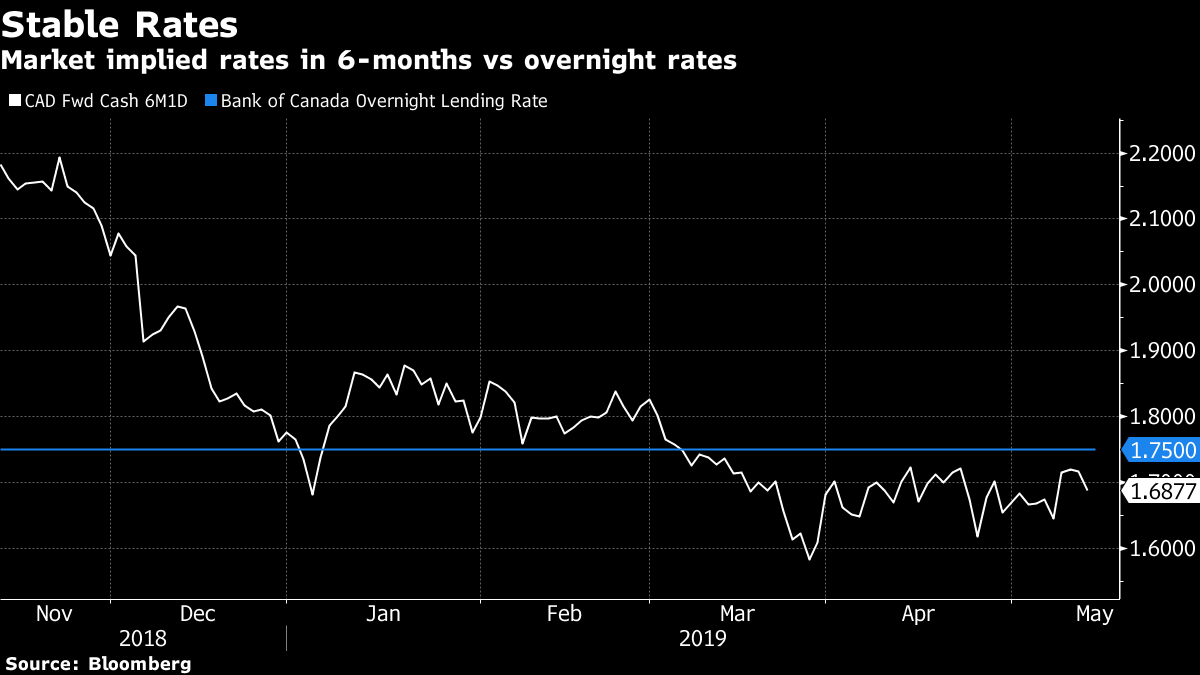
Capital Economics estimates that the Bank of Canada will cut rates twice this year, dropping the benchmark rate to 1.25 per cent, from 1.75 per cent. That’s far from consensus, with implied policy rates in the swaps market signaling just one rate cut over the next two years, Bloomberg data show.

The research firm expects that families will have to use a bigger portion of their income to bolster savings because home equity will be constrained by muted price gains.

Embedded Image

New home sales in Toronto declined at the start of the last year and remained flat since then, averaging 25,530 units per month, compared with a monthly average of 46,841 units in 2017, according to data from real estate consultant Altus Group. The housing starts adjustment is just beginning, with monthly averages since January 2018 at 39,301 units, compared with 39,703 units on average in 2017, according to data compiled by Capital Economics based on Statistics Canada data.

“Condo developers have to sell about 70 per cent of the units in their condo before they start construction, in order to secure financing,” Brown said. “So the current housing starts represent homes that were actually sold, as pre-construction units, around 18 months ago.”

He added that a similar trend is playing out in Vancouver.

“It’s a niche data that not many are looking at it,” he said.


Source

May 7, 2019

Making Housing more Affordable: First-Time Home Buyer Incentive

The recent federal Budget proposed a series of incentives that demonstrates the government’s commitment to housing affordability, and CMHC is proud to take a leading role in many of them. We know that you’re particularly anxious for details regarding the new First-Time Home Buyers Incentive (FTHBI).

Affordable home ownership is a pressing concern for many young Canadians. This program was designed to help you without undoing the progress we’ve already made through measures that prevent excessive borrowing and limit house price inflation.

Like other Budget incentives, the proposal requires some government approvals. We also plan to consult with lenders and other industry participants to make sure the program works as intended.  As a result, we still have work to do. While we can’t yet share all program specifics, we can nonetheless elaborate on the program’s intent and some of the rationale behind its design.

A partner for your home purchase

The FTHBI is a program that will assist qualified first-time home buyers without adding financial burden. As there are no monthly payments, it will free up income to pay for other everyday expenses.  Unlike some of the other assistance programs tried in the past, the FTHBI will also require borrowers to meet minimum insured mortgage down payment requirements, ensuring they are invested in their purchase.

Supply measures moderate price growth. By doubling the incentive for purchasers of new homes, it encourages new supply to meet housing demand.

Indeed, by helping first-time home buyers purchase homes, we will free up rental supply, easing pressure on rents. This, along with the expanded Rental Construction Financing program, will add to the supply of affordable rental housing. Core housing need is four times higher among renters among homeowners. (26.4% versus 6.5%)

Targeted to avoid increasing house prices

We have carefully targeted the FTHBI to help younger Canadians having trouble affording home ownership. The program is capped at $1.25 billion over three years. The incentive will be limited to households with a maximum combined income of $120,000 and total borrowing is limited to four times income.

We do not expect the FTHBI’s inflation effect to be beyond a maximum of 0.2-0.4 per cent.

Limiting house price inflation will keep housing more affordable, more so than some of the other suggested policy and regulatory changes. For example, a reduction of one per cent in the mortgage insurance stress test or an extended amortization limit of 30  years would have added to indebtedness and resulted in house price inflation of five to six times more than this maximum.

Available throughout Canada

Despite the income and borrowing limits, we are confident this program can work in all markets, including Vancouver and Toronto. The average insured home in Canada is worth $284,000, less than the national average house price of $470,000 and this program applies up to a house price of $505,000, assuming a 5% down payment. However, we shouldn’t confuse market average prices ($1 million in Vancouver and $770,000 in Toronto) with starter home prices.

It may not be a condo in Yaletown or a house in Riverdale, but there are options in both metropolitan areas to accommodate this program. In fact, around 23% of transactions in Toronto are for homes under $500,000 and 10% in Vancouver. It is very difficult to estimate the demand for the Incentive; however, based on last year’s activity — more than 2,000 home buyers in Toronto would have been eligible for the FTHBI and over 1,000 in Greater Vancouver.

Stay tuned

#askthecret for more details. 

Source

April 30, 2019

Scrapping Mortgage Rules Would Boost Canadian Home Prices

The Canadian government should consider being flexible on its new mortgage lending rules because the impact has been longer-lasting and more significant than originally intended, Toronto-Dominion Bank says.

Home sales were about 40,000 lower between the final quarter of 2017 and the same period a year later than they otherwise would have been without the rules, according to a note to clients Tuesday by TD economists Rishi Sondhi, Ksenia Bushmeneva and Derek Burleton. That translates into about a 7 per cent decline in sales, they said.

There is also evidence of a shift in business to private lenders who are not subject to the rules, known as B-20 and implemented by Canada’s banking regulator. The economists estimate the share of borrowers in Toronto accessing funds from alternative lenders increased to 8.7 per cent in the second quarter 2018, from 5.9 per cent in the same quarter a year earlier.

The changes mean federally regulated lenders must now run a 200 basis-point stress test on new mortgages, to ensure the quality of lending remains high amid escalating home prices. The measures are disproportionately affecting first-time homebuyers, who normally account for between 40 per cent and 50 per cent of the market, as well as cities that have more youthful demographics like Toronto and Vancouver, TD said.

‘One-Size’

“Right now it’s a one-size-fits all type of policy, and borrowers differ in their ability to service their mortgage, and they’re different in terms of their risks,” Bushmeneva said in a phone interview. She said policy makers could consider being flexible around the 200 basis point stress test limit, given it’s “somewhat arbitrary,” and doesn’t take into account the credit-worthiness of borrowers or their life stage.


Immediately removing the rules would increase Canadian home prices an additional 6 per cent, on top of Toronto-Dominion’s current forecast for a 4 per cent increase, by the end of 2020, the economists wrote, adding that would boost home prices by about $32,000 on average.

The rules have pushed potential buyers into the rental market, leading vacancy rates for purpose-built rental units to fall by as much as 30 basis points in Toronto and Vancouver. That poses a “significant challenge” as those markets are already “severely under-supplied,” with current vacancy rates at just 1 per cent, the economists wrote.

Toronto-Dominion joins fellow-lender Canadian Imperial Bank of Commerce, along with realtors and builder groups in calls for the government to revisit its B-20 rules.

According to the note, Toronto-Dominion also forecasts:

  • Housing starts to trend lower through 2020, as B-20 crimps market for new housing
  • New housing construction will be a drag on growth next year, though healthy job gains and robust population growth will provide a floor. Currently, the bank sees Canadian home prices stabilizing by mid-year and rising 4 per cent by end of 2020
  • However, if B-20 was immediately removed, nationwide sales and prices could be about 8 per cent and 6 per cent higher by end of 2020, equating to about $32,000 difference in avg Canadian home price, with disproportionate impacts in Toronto, Vancouver.
  • Removal of B-20 would represent a “significant near-term boost to housing activity, though at a longer-term cost of worsened affordability”


Source: BNN Bloomberg

April 25, 2019

Bank of Canada's Poloz poised to put rates on prolonged pause

Bank of Canada Governor Stephen Poloz is widely expected to cement expectations for a prolonged pause on interest rates on Wednesday, as the nation’s economy grapples with a slowdown.

All 24 analysts surveyed by Bloomberg see policy makers leaving the benchmark overnight rate at 1.75 per cent in a decision at 10 a.m. in Ottawa. It would mark a fourth straight hold by the Ottawa-based central bank.

The more important question is whether a run of disappointing Canadian economic data, coupled with slowing global growth and concerns about a U.S.-China trade war, prompts Poloz to formally put an end to his rate hiking cycle, after five increases since the middle of 2017. Even amid all the recent concern, Poloz has been reluctant to fully abandon the idea that his next step is likely higher -- making him a bit of an outlier.

“The Bank of Canada is still one of the most hawkish central banks globally, and I expect Governor Poloz is going to want to maintain some optionality” to raise rates, according to Frances Donald, head of macroeconomic strategy at Manulife Asset Management LLC. “Full capitulation like we’ve seen from the Federal Reserve or the European Central Bank in my view is unlikely,” she said.

The case for a prolonged pause has grown significantly in the months since Poloz last raised borrowing costs in October. Canada’s economy stalled in the final quarter of last year, as oil prices tumbled and households reined in spending. Data for the early months of 2019 continue to be sluggish at best.

The end result is an economy that is probably operating with more slack than the Bank of Canada anticipated when it last released its quarterly forecasts in January. That’s one of the reasons swaps trading suggests investors are more likely to be betting on a Bank of Canada rate cut over the next year, rather than a hike.

Yet, there are also good reasons why Canada’s central bank may want to maintain a modest tightening bias. Given the country’s status as a high-debt nation, for example, Poloz may want to keep the prospect of higher rates alive to prevent another borrowing binge, according to Donald.

“Unlike the U.S., the Bank of Canada may be looking to continue a gentle deleveraging,” the Manulife economist said.

Poloz has also been skeptical about the merits of fine-tuning policy on the back of limited data, and may have an aversion to a complete shift in stance until the economic case becomes overwhelming. And there’s no indication that’s happened, with oil prices recovering and amid signs that China and the U.S. are edging closer to an end to their trade war.

Throughout the recent downturn, the central bank has stuck to its expectations of a rebound from the current soft patch.

At the same time, the Bank of Canada has been hedging. Its officials have spent the last few months diluting their conviction on higher rates, taking an incrementally more dovish stance in each of its past three rate statements while being careful not to entrench persistent market bets for a cut.

Until recently, the idea has been to inject ambiguity into the timing of rate hikes, while sticking to an overall belief the next move will be up. But in recent weeks, Poloz has also stopped talking about higher rates altogether, raising speculation he’s planning to formally drop the hiking bias.

This “week should see the last vestiges of a tightening bias dropped by the Bank of Canada in its rate statement,” Mark Chandler, head of fixed income research at Royal Bank of Canada, said in a note to investors.

Asked at a press briefing April 13 in Washington whether he’s done with hiking, Poloz said: “That’s a very data dependent question.” He also dismissed the idea the central bank has any specific target for borrowing costs in the long term, and played down the significance of the Bank of Canada’s recent references to the “neutral” rate in its statements.

The neutral rate estimates the final resting place for borrowing costs. It’s currently forecast between 2.5 per cent and 3.5 per cent, which is above the policy rate. The Bank of Canada’s decision to include the concept in its rate statements late last year was read as a nod to rate hike plans.

As part of Wednesday’s quarterly monetary policy report, however, the Bank of Canada may revise down the estimate for neutral, implying current policy is tighter than previously assumed and giving Poloz one more reason to pause.

Source: Bloomberg

Jonathan Quinlan

TD Mortgage Specialist 

jonathan.quinlan@td.com

587-707-9209


Posted in Mortgage Updates
Nov. 28, 2018

Carrying Two Mortgages While Planning to Sell

After their son graduated from college, Jim & Teresa decided to follow their daughter and her family to Calgary so they could be part of their grandkids’ lives.

Everything seemed to be falling into place quite nicely. After a quick trip to Calgary to look for a home, they found exactly what they were looking for and the date was set. Their daughter and her husband were ecstatic that their kids would get to know their grandparents! After some discussion, their son decided to follow suit and join them on their journey. It had become a family affair. New province, new adventures.

The only outstanding item was selling their acreage. No small feat.

As their moving date drew closer it became apparent that Jim & Teresa’s house would not sell in time, or before their mortgage renewal came due.

This is a real life circumstance and it happens. What do you do when plans don’t line up exactly as you want, or need, them to? How do you plan for the unplanned? What options are there when you are faced with a fairly substantial challenge like this one?

Carrying two mortgages isn’t always feasible, but in the short term it may be your best option. In a case like this, one of the best alternatives is to speak with a Mortgage Broker to provide information and guidance on the best solution that will help you in the short term.

It’s never an easy decision to make when faced with carrying two mortgages, but when you know your circumstances are tentative and may quite possibly change in the near future, vetting it out is worth your time and energy.

Written by: Kristi Hyson with Axiom Mortgages (kristi@kristyhyson.com)

Nov. 28, 2018

Deciding Which Mortgage Makes Sense

Deciding which mortgage makes sense can be difficult, I’m here to help.

There are several factors to consider when making a decision about the best mortgage solution. From terms and rates to flexibility and type of mortgage, I will assess your unique needs and present the best solutions.

Choosing the right type of mortgage solution could save you money in the long term.

1. A Fixed Mortgage - offers you the security of locking in your interest rate for the term of your mortgage, so you know exactly how much principal and interest you will be paying on the mortgage during the term. Terms range from 1 year to 10 years. Fixed rate mortgages can offer some form of pre-payment, from 10% to 20% of the original mortgage amount each year, depending on the lender.

If you wish to pay off your mortgage in full, there will be a penalty of either 3 months simple interest, or an Interest Rate Differential (IRD). Not all fixed mortgage penalties are calculated the same. Some lenders charge higher IRD penalties then other lenders. It is a good idea to question how the IRD payout penalty on a fixed mortgage is calculated.

Sometimes “life happens” and if you have to payout your mortgage prior to maturity you’ll want to ensure the penalty is reasonable. A mortgage broker can present lenders who offer favorable penalties on fixed rate mortgages.

2. Variable Rate Mortgage - allows you to take advantage of today's low Prime Rate. Most variable rate products are set below prime, terms range from 3 years to 5 years. Payments vary depending on the product or lender you choose.

In some cases, you can fix your payments for up to 3 years or 5 years, but the interest rate will fluctuate as the Bank Prime Rate changes. In other cases, your monthly payments will fluctuate depending on how many times the Prime Rate changes during your term. Variable rate mortgages can offer some form of pre-payment, from 10% to 20% of the original mortgage amount each year, depending on the lender.

By: Kristi Hyson with Axiom Mortgages (kristi@kristihyson.com)

Posted in Buying Trends
Oct. 17, 2018

The 3 Types of Markets


When you begin the home buying or selling journey, there may be several terms used that you’re unfamiliar with. Buyer’s market? Seller’s market? Balanced market? To help get you started, we’ve broken down the difference between a buyer’s market and a seller’s market below.

Buyer’s Market: There are more homes on the market than there are buyers.

In this type of market, buyers will spend more time looking for homes. There are more homes on the market, giving the small number of potential buyers more to choose from. The prices of homes can be stable or perhaps dropping. Sellers will find that buyers have stronger leverage when negotiating.

Seller’s Market: There are more buyers than there are homes for sale.

With fewer homes on the market and more buyers, homes sell quickly in a seller’s market. Prices of homes are likely to increase, and there are more likely to be multiple offers on a home. Multiple offers give the seller negotiating power, and conditional offers may be rejected.

Balanced Market: There are the same amount of homes for sale and buyers.

When there is equal competition between buyers and sellers, this means that there are reasonable offers given by buyers and homes sell within a reasonable time. With less tension between buyers and sellers, the prices of homes remain stable.

Before buying or selling a home, it is important to find out what type of market you are entering into. Your listing price, negotiations and expectations will all be affected depending on whether it is a buyer’s market or a seller’s market.

Talk to a real estate agent: Our agents are always willing to help with all of your real estate questions. They not only know the local market inside and out, but they have experience pricing and selling homes in your area. 

Posted in Investor's Lounge
Oct. 17, 2018

Are You Ready to Buy a Home?

Make Sure You’re Ready

If you’re thinking of buying a home, you’ve come to the right place. Once you’ve decided you’re ready to buy, The Calgary Real Estate Team can guide you through the entire process.


Are you ready? Be sure.

Few joys can match the pride of owning a home, but the responsibility can also come with sacrifices – from the financial commitment to the required care and maintenance. You’ll want to be sure both fit within your current or preferred lifestyle.


Is your bank account ready? Check it twice.

Buying a home is likely the most significant and largest purchase of your life. Do it right with the help of a REALTOR® and avoid regretting taking on more than you should. It’s ideal to have saved up some money and manage any debt. Speak with your bank or #askthecret for a preferred mortgage broker to help determine how much you can qualify for. 


Is right now a good time to buy?

Markets go up, markets go down and even the most informed experts can’t accurately predict when a market will peak or bottom out. If you’re buying a home as a long-term investment (and for long-term enjoyment), you should be protected from short-term changes in the market. Instead, focus on picking a home that meets your and your family’s needs.


Where do You Want to Live?

Whether you’re new or native to a neighbourhood, a REALTOR® can help you navigate homes in the areas that best suit your needs and lifestyle.  Take a minute to reflect on these popular housing options to help decide what fits you best.


Urban

Sure the prices are generally higher, but you can walk to a restaurant, maybe even to work. You’ll also have the widest range of housing options.

Suburban

Newer schools, modern shopping centres, bigger yards, and bigger homes are just a few of the reasons many people flock to the suburbs.

Rural

Rural living isn’t for everyone but if owning a few (or many) acres of seclusion is your idea of heaven, be sure to expand your search beyond the city lights.

Smaller cities and towns

Smaller cities and towns in Canada are dotted with thousands of wonderful self-contained communities and, compared to the big city, you can save a bundle.


What Type of Home do You Want?

Whether you’re building a home from the ground up or giving new life to a home previously loved by others, a REALTOR® can help narrow down a type of home to meet your needs.

Single-family detached

As the name implies, the home is freestanding and not attached to any homes next to it.

Semi-detached or linked

Two distinct houses (with separate owners and lots) that are built side-by-side and share a common wall.

Duplex

A building on a single lot but that is zoned for two families (each with independent access).

Town house

Also known as terrace or row housing, they’re identified as homes featuring a common style and joined in a row. They usually share common walls on both sides

Condo

With a condo, you own 100% of your unit and a share of the common areas. Common areas include the necessary plumbing, electrical systems, hallways and elevators. They may also include amenities like a private gym or pool. On top of the mortgage and property taxes, condo owners also pay a monthly fee to operate and maintain the common areas.


Sell Your Current Home

If you’re not planning to own two homes at the same time, you’ll need to sell the one you have now. So, do you buy or sell first? Many people are able to time their sale and purchase to happen on the same “closing date,” making their purchase offer “conditional” on the sale of their current home or by extending the “closing period” to give more time to find the perfect home. A REALTOR® can help you decide the best time to enter the market, analyze local market trends to set an agreeable and appropriate price and help promote your home to potential buyers.

Seller’s market

When lots of people are looking for homes but there aren’t many for sale.

Buyer’s market

When there are many homes for sale but not enough people buying them.

Seasonality

This refers to the fact that winter sales tend to be slower in most markets while spring sales typically speed up.


Posted in Buying Trends
Oct. 17, 2018

6 Reasons Why Selling a House in the Winter is Smart


Spring is generally the most popular time of year to sell a house, with hordes of buyers looking to move into a new place before the school year begins. But if you decide to sell your home during the winter, experts say you could reap a reward in cold, hard cash. Read on for the top reasons why you should consider unloading when the temperatures drop.

1. Low inventory = less competition

Since spring is the most popular home-selling season, the housing market is ultracrowded with options at that time of year. And if you paid attention during Econ 101, you understand the law of supply and demand.

“Most sellers still think they need to sell in the spring, but that means there is more competition for buyers' attention,” says Matt Van Winkle, founder of Re/Max Northwest in Seattle.

But in the winter, there are fewer homes for sale. That competition over low inventory can make winter an ideal time to sell your home.

“In the Atlanta market, January is one of the strongest months for homes to go under contract,” says Ally May of Atlanta Fine Homes Sotheby's.

2. You get to show your home’s winter-readiness

Selling in the winter also gives you the opportunity to show that a home is designed to handle the harsh elements.

“Sellers in places like Lake Tahoe can show off features like a south-facing driveway to speed up snow melting, how snow will fall off of a roof, a short driveway that will minimize shoveling or plowing, heat tape on the north side of the roof to avoid snow accumulation, and how recently the roof and furnace have been replaced," says Sandy Soli, regional manager at Engel & Völkers in Lake Tahoe, NV.

Plus, during winter months, homes with features like fireplaces and hot tubs are certainly more appealing.

3. New parents may be looking to upgrade

The baby boom in September may lead to more buyers later in the year. According to data from the Center for Health Statistics and the Social Security Administration, there are more birthdays in the month of September than any other time of the year. Therefore, there's likely to be a crop of growing families looking to buy a larger house.

"Once baby is home and settled, these parents may want to start the year in a new, and more spacious, family home,” according to Melissa Temple, real estate adviser and partner at Engel & Völkers in Aspen, CO.

4. Winter brings out the serious buyers

News flash: Not everyone looking at houses intends to make a purchase. Some people are contemplating moving and may just want to see what's on the market. Since more homes tend to go on the market in spring and fall, this is also when window shoppers are likely to be out looking.

However, these looky-loos tend to be scarce during winter months, according to Jennifer Baldinger, licensed associate real estate broker at Julia B. Fee Sotheby’s International Realty in Scarsdale, NY.

"When I have buyers looking for homes in January and February, they’re real buyers looking to make a purchase—especially if it’s a great house. They don't want to take the chance of waiting until spring and losing out on the home,” Baldinger says.

“There may be less people at these open houses, but I would rather have 10 real buyers come through than 20 people who are just curious,” she says.

5. Year-end financial bonuses and payouts

As a seller, year-end performance reviews could mean that more people have money to spend on a home.

“End-of-year financial bonuses or workers retiring with large payouts could mean opportunities for these buyers to upgrade their living situations or for first-time buyers to enter the housing market,” according to Temple.

6. Corporate relocation

You could also encounter buyers who are relocating for a job.

“One of the biggest months for corporate relocation is January/February, so those buyers, who need to move quickly, are out in full force looking for new homes,” Baldinger says.

Relocators typically have a limited amount of time to uproot their families and, as a result, don't have the luxury of spending a lot of time looking at properties. The kids need to get settled into school, and dealing with selling their old home can add another level of urgency and stress. So it's likely that once they find a home that meets their requirements, these buyers will be ready to sign on the dotted line.

Posted in Selling Trends